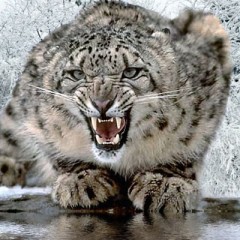
 On 5 - 18 May 2011 with support of WWF of Russia and WWF of Mongolia, trans-border areas of snow leopard habitat were observed. The density of evidence of irbis life activity is comparable to the best habitats of this species in Nepal and India.
Experts of the international expedition observed the Mongolian part of Tsagan-Shibetu range (nature preserve "Tsagaan-Shuvuut") and Chikhachev ridge (area of national park "Silkkhemin Nuruu"), adjacent to Russian border. A group of irbis inhabits this trans-border zone, the study of which is exceptionally important for protection of this rare predator in Russia and Mongolia.
Staff of Altai nature preserve, of Institute of Biology of Mongolian Academy of Sciences, WWF of Mongolia, anti-poacher brigade "Irves" (Mongolia) and Administration of specially protected natural territories of lake Uvs-Nuur basin and Mongolian Altai participated in the expedition.
The density of traces of irbis life activities was of very high density on some areas observed by scientists. Claw marks, scratching spots (where the animal sharpens its claws), smell marking sites, paw prints or remains of irbis' prey were seen to a frequency of 30 marks per kilometer of trail. This number is comparable to the best areas of irbis habitat in northern India and Nepal. Experts also collected more than fifty excrement specimens, in order to determine by DNA analysis the sex and numbers of animals in these groups.
During the expedition immediately adjacent to Russian border, a video was obtained - images of the irbis. Scientists set up automatic cameras on Chikhachev ridge in an area of many snow leopard tracks, and already within a few days - success! An irbis jumped from a large boulder right in front of the camera, and without hurry walked away through a narrow canyon.
The data collected as a result of observations testify: snow leopards live within this territory permanently, and the grouping of the species is stable. Total number of the trans-border grouping on Chikhachev ridge is estimated by WWF experts as 10-12 individuals (9-10 irbis individuals from the Mongolian side of Tsagaan-Shibetu ridge, and no fewer than 1- irbis individuals on the Russian side of this ridge and adjacent southern part of Shapshal ridge.
Regardless of their apparent small number, snow leopards inhabiting this area of Russian-Mongolian border are the connecting link between small Russian groupings of this predator, and the core of the population in Western Mongolia mountains.
On Mongolian territory, snow leopards live under protection of "Tsagan-Shuvuut" preserve and "Silkkhemin Nuruu" national park. On the Russian side on Chikhachev ridge and Tsagan-Shibetu, unfortunately, any specially protected natural territories are lacking.
Currently WWF experts are evaluating the possibility of creating a national park "Sailyugemskiy" in the southern part of Chikhachev ridge in Gornyi Altai, as well as a cluster of the "Ubsunur depression" preserve in the southern part of Tsagan-Shibetu ridge (Republic Tyva).
Creation of these specially protected territories and effective co-operation with Mongolian nature protection organizations will allow the preservation of snow leopards - animals who do not respect formal state borders - in this trans-border territory.